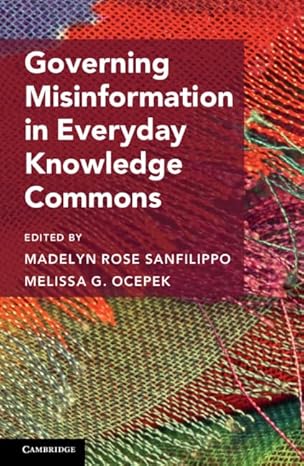
Governing Misinformation in Everyday Knowledge Commons (Madelyn Rose Sanfilippo and Melissa G. Ocepek, eds.) (Cambridge University Press, 2025)
Governing Misinformation in Everyday Knowledge Commons delves into the complex issue of misinformation in our daily lives. The book synthesizes three scholarly traditions – everyday life, misinformation, and governing knowledge commons – to present 10 case studies of online and offline communities tackling diverse dilemmas regarding truth and information quality. The book highlights how communities manage issues of credibility, trust, and information quality continuously, to mitigate the impact of misinformation when possible. It also explores how social norms and intentional governance evolve to distinguish between problematic disinformation and little white lies. Through a coproduction of governance and (mis-)information, the book raises a set of ethical, economic, political, social, and technological questions that require systematic study and careful deliberation.
CONTENTS
Introduction: Governing Everyday Misinformation by Melissa G. Ocepek and Madelyn Rose Sanfilippo
Storytelling and/as Misinformation: Storytelling Dynamics and Narrative Structures for Three Cases of COVID-19 Viral Misinformation by Kate McDowell
It’s Not (All) about the Information: The Role of Cognition in Creating and Sustaining False Beliefs by By Dominique Kelly and Jacquelyn Burkell
Information Hazing: An Examination through Computer Science Education by Elizabeth Wickes and Melissa G. Ocepek
Common Nonsense about Password Security and the Expert–Layperson Knowledge Gap by Brett M. Frischmann and Alexandria Johnson
Hacks, Fakes, and Hot Takes: Moderating “Bad Actors” on Google Maps Local Guides Platform by Rebecca Noone and Aparajita Bhandari
The Human Infrastructure of Misinformation: A Case Study of Brazil’s Heteromated Labor by David Nemer and William Marks
Hidden Virality and the Everyday Burden of Correcting WhatsApp Mis- and Disinformation by Britt Paris and Irene Pasquetto
“Do Your Own Research”: Everyday Misinformation and Conspiracy in Online Information Worlds by Gary Burnett and Shannon Williams
How to Manage Issues on Twitter: Perspectives from Twitter Users Concerned about Mis/Dis-Information by Joanna Sin Sei-Ching and Kyung-Sun Kim
Accepting and Expecting Deception: Community Governance of False, Fabricated, Omitted, and Out of Context Claims on Instagram by Madelyn Rose Sanfilippo and Smita Katherine Nair
Co-constructing Misinformation and Community: Some Conclusions by Madelyn Rose Sanfilippo and Melissa G. Ocepek
ABOUT THE EDITORS
