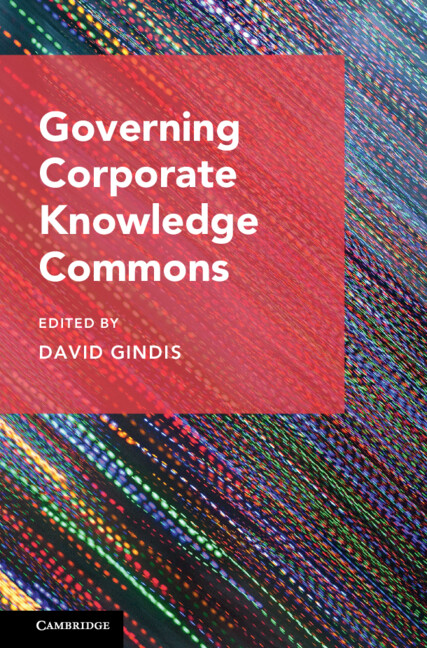
Human interactions, in any group or social setting, rely on and generate shared knowledge and social understandings. These shared intellectual resources are just as important to the efficient operation of markets and organizations as are their shared legal and material infrastructures. Governing Corporate Knowledge Commons focuses on the formal and informal arrangements that govern the creation and community management of intellectual resources within and across organizational boundaries. It demonstrates how the Governing Knowledge Commons (GKC) framework can be fruitfully combined with existing theoretical work on firms and corporate governance found in economics, management, and sociology. The volume also proposes a new set of case studies, ranging from old industrial enterprises to modern venture capital, investor alliances, and decentralized autonomous organizations. Chapters explore the benefits of participatory approaches to the management of genomic or financial data, online gaming communities, and organic waste.
CONTENTS
Introduction: Varieties of Corporate Knowledge Commons by David Gindis
Toward a Knowledge Commons Perspective on the Corporate Form by David Gindis and Daniel H. Cole
What Do Corporations Do? by Joshua Getzler
Managing Knowledge in Bat’a Enterprises by Marek Hudik and Martin Komrska
Institutional Complementarities in the Governance of Corporate Knowledge Commons by Erkan Gürpinar
Who Owns a Corporation? Common-Sense Commons and Corporate Governance by Tanweer Ali
Corporate Governance and Knowledge Commons by Jeroen Veldman
Venture Capital as a Commons by Simon Deakin and Hanna Sitchenko
Investor Alliances as Knowledge Commons by Amelia Miazad
Data Commons, Data Oligopolies, and Consumer Financial Data Trusts by Alberto R. Salazar and Andi Rezda Rezal
Decentralised Autonomous Organisations as Commons by Sinclair Davidson
The Decentralized Autonomous Corporation as Knowledge Commons by Michael J. Madison and Ilia Murtazashvili
The Human Genome as Knowledge Commons: Governance through Mutual-Benefit Participatory Democracy by Benjamin Gregg
Commoning through Interactions: Governing Offline and Online Communities in the German Video Game Influencer Industry by Deike Schulz
Supply Chain Commons: Organic Waste, Climate Change, and Regenerative Farming in Peri-urban Sydney by Stephen Healy, Amy J. Cohen, and Abby Mellick Lopes
ABOUT THE EDITOR
David Gindis is Associate Professor at the University of Warwick School of Law
