
The GKC framework is available to and can be used by researchers in many fields and disciplines: information science and informatics; socio-technical systems; economics; political science; international relations; public policy and public administration; law, including not only intellectual property law but also a wide range of law-related fields, including law and technology and law and economics; history; computer science and computer engineering; and the history and philosophy of science.
Here are excellent starting points for understanding the GKC research framework, for adapting the rhetoric, syntax, and practices of GKC research to the foundational methods of various disciplines, and for getting started on GKC-themed research. A detailed explanation of the Governing Knowledge Commons (GKC) framework is available here.
Briefly: The framework, in a single image:
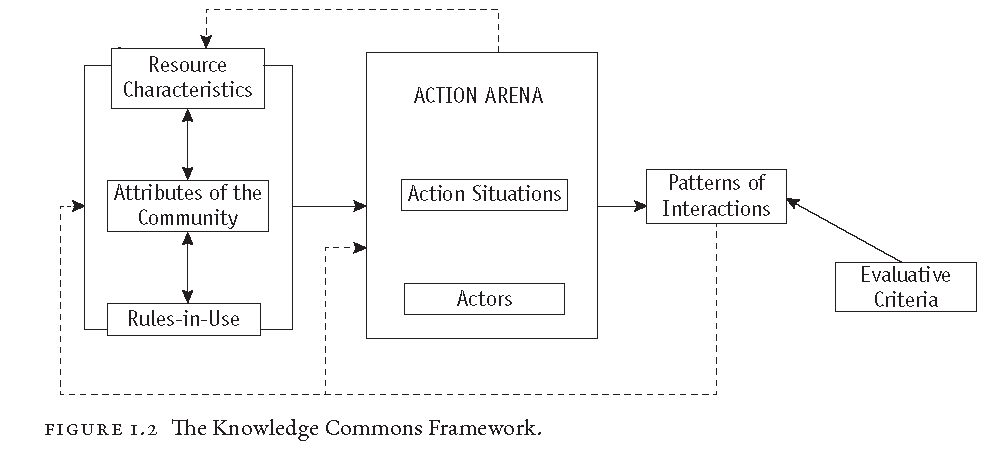
Source: “Governing Knowledge Commons,” in Governing Knowledge Commons (Frischmann, Madison, & Strandburg eds., Oxford University Press 2014) at 19; originally published in Michael J. Madison, Brett M. Frischmann, and Katherine J. Strandburg. 2010. “Constructing Commons in the Cultural Environment.” Cornell Law Review. 95(4): 657-709. Adapted from Elinor Ostrom, Understanding Institutional Diversity (Princeton University Press 2005).
Researchers using the framework often pair it with research methods and intuitions drawn from other disciplines, particularly intuitions that focus on institutions and comparative institutional analysis.
Those intuitions lead to starting questions, where answers and further questions can be refined iteratively in the context of the GKC framework.
Starting questions may include:
Is there a context – a sector, a community, an organization – that produces and/or relies on information, knowledge, or data sharing? Polycentric and nested institutions are particularly fruitful and important settings for knowlege commons governance.
What social dilemmas (plural) are associated with those sharing practices? Social dilemmas may produce conditions that lead to knowledge commons governance; knowledge commons governance may produce social dilemmas.
What governance institutions and practices have been built or have evolved to respond to and manage those social dilemmas? Institutions and practices in the knowledge commons context characteristically have features of boundedness and openness as to both the community itself and as to the shared knowledge, information, and data resources.
This brief document offers several illustrations of knowledge commons governance in practice.
Last updated: June 2026
